Monday, July 19, 2010

Advancing on Many Fronts


Operations-wise, I've built the switching area at Thomas, including a new industry switch for Kingsford Charcoal. Kingsford wasn't actually located in Thomas, but at Parsons a few miles down the hill. But it will add some interesting rolling stock to the subdivision, having used the WM's fleet of 60' cushion framed boxcars.

There's also a home for the old Meyersdale Farmer's coop from the previous track plan, plus a team track ramp, and of course, the big coal tipple. I've got two more switch throws to install, and some wiring drops to hang from the switchback, but otherwise this section is complete and ready for paint and scenery.


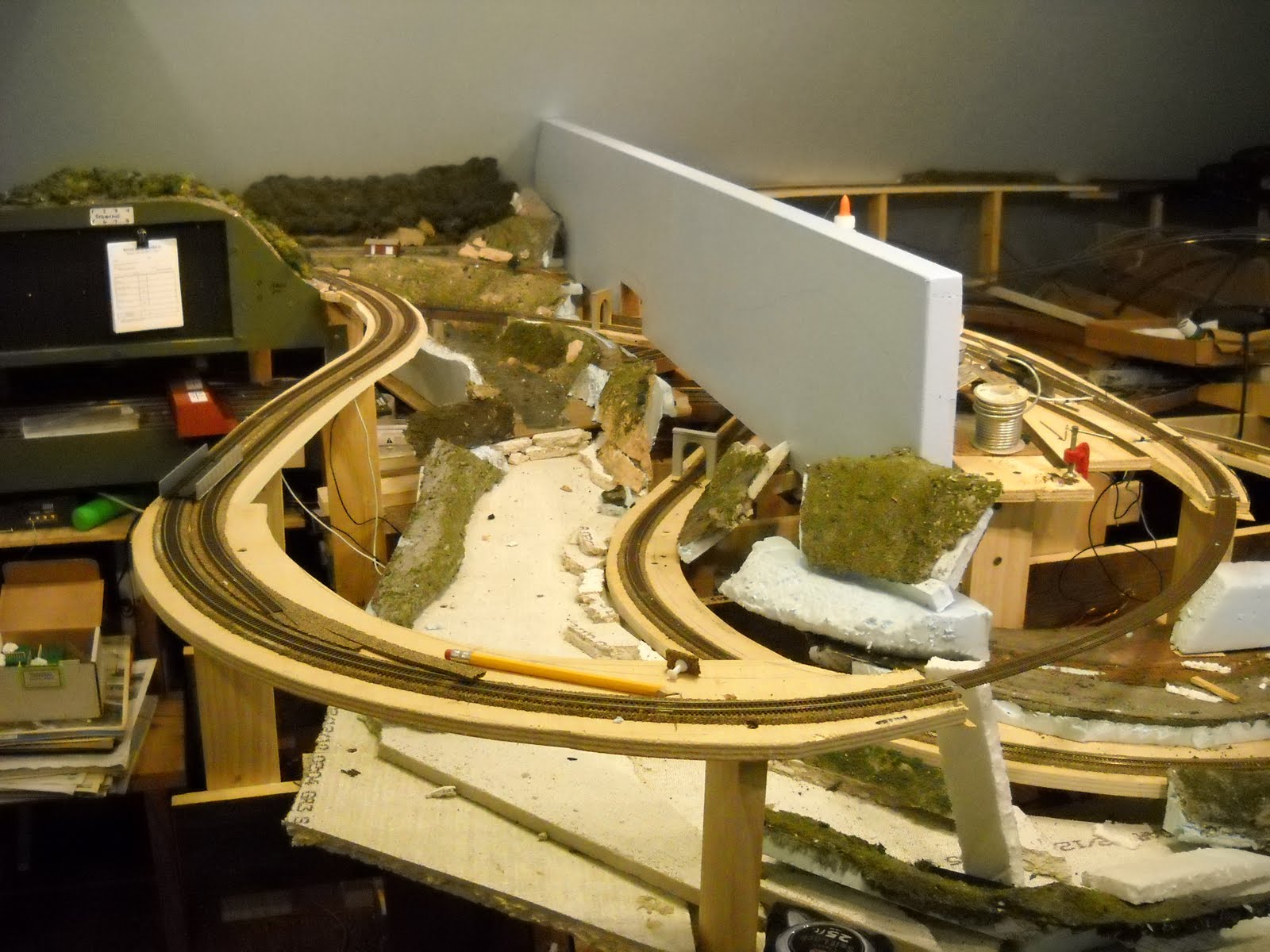
In the trackwork department, I extended the western frontier of the Connellsville line, which is the two-track line that comes in at the left and then arches over the staging yard. This will eventually extend across the front wall to a helix, and thence down to the west end staging. With that bit of benchwork constructed, I could add the most visual feature of the new work to date:
...the curved skyboard that will provide the backdrop for Cumberland's urban scene, and which conceals the helix on the Thomas Sub. Naturally, after weeks of running trains up and down the helix without a problem, as soon as I installed this, I had one train suffer a derailment, and another a random uncoupling, inside the corkscrew, of course. Hopefully I won't live to regret this design compromise...

I think in both cases the problem was related to a stalling locomotive, so I sent the MOW crew up and down a few times with the track cleaning car. Hopefully that will prevent, or at least minimize, future problems.

The Bridge Department has all the materials needed to finish the High Bridge east of Thomas, I just need to take some time to sit down and build the last 80' girder span, then fabricate some bridge feet.


Electrically, I installed my first accessory decoder to run a pair of turnouts on the Thomas Sub. This is a major breakthrough for me. The decoder was certainly cheap enough, and it's an absolute delight to stand on one side of the layout and throw a switch without having to dive to a control panel on the other side of the room. There will be more of these installed, I assure you!

Things on the peninsula are really shaping up, and I expect I'll be cutting some foam and sculpting out the landscape shortly.

Thursday, July 8, 2010

Take Me to the River

Since the last time we chatted, I've made some significant headway on some basic scenic elements in the new section. I had started working on the dull stuff, wiring switch machines, mostly, when I decided (with the help of my adult ADD)to switch gears and work on something else.

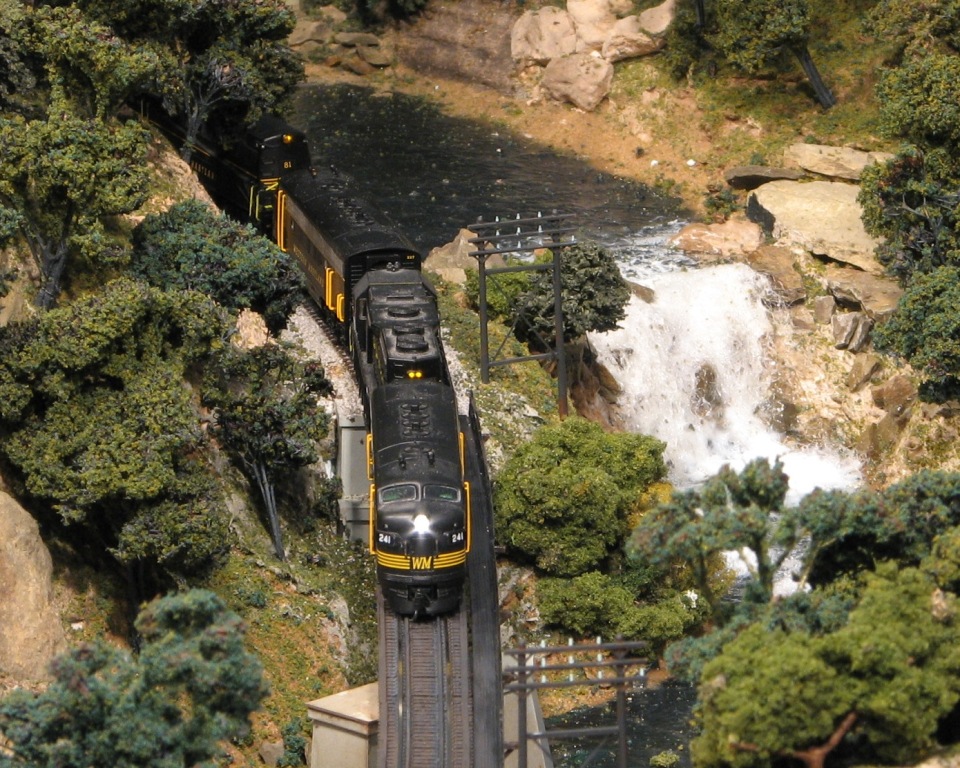
Since the Casselman Crossing scene on the original layout turned out so well, my thoughts turned to the extension of the river into the new section. With the sweeping curve of the new Connellsville Line on the right, and the lofty, cliff hanging Thomas Sub high above on the left, this area promises to be a good spot for railfanning.


So off to the garage I went, in search of odds and ends to help me get started. First I needed something for the riverbed. I have a ton of plywood, homasote, and masonite out there, but for this purpose I chose a chunk of broken ceiling tile I had scavenged from somewhere. The river will step down in another falls near the new Connellsville line tunnel, so it can drop down to a level lower than that line's right of way. A little further along, and it will drop through some rapids reminiscent of the big hook in the Youghiougheny near Ohiopyle State Park in southwestern Pennsylvania.

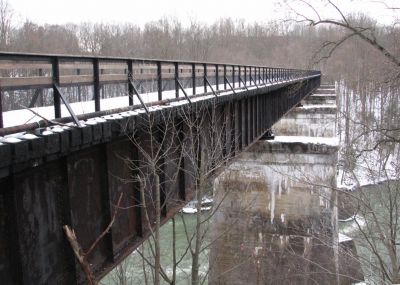
This visual will help create a scene that will remind viewers of Ohiopyle, as the Thomas Sub will cross this gorge on a high, gently curving steel bridge at this location.


In addition to the river bed, I obtained a 12" door panel that has been pressed into service as a skyboard, which splits the new peninsula into two distinct scenes. On the left side of the view block is this river gorge. There are virtually no switching opportunities here, and it's designed to be the scenic "signature" of the railroad. On the other side, the peninsula is lousy with switching, with Thomas on the upper level with its sawmill and coal loaders, and just around the corner, Cumberland with its industrial districts. With the addition of the skyboard divider, the railroad is really beginning to take shape in this area.
I've also been steady working on the high bridge, and thanks to the contribution of a couple of Micro Engineering bridges from Daryl Kruse, we're moving right along with that project. I've been casting bridge piers from Plaster of Paris, which will allow me to really begin to get the scenery moving along in this area. All of the wiring under the river is more or less complete, which will also permit me to charge ahead with this phase of the project.

Once the bridge is completed, I can go back to that dull wiring business.

Thursday, July 1, 2010

All the way to Elkins!

All that's left now is to wire the Tortoise switch machines to operate from the Elkins panel. Using a little help from a 9v battery, I was able to stage a train from Maryland Jct. all the way into the Elkins Yard, and then reciprocate with another train headed back. Here's the evidence...


Enjoy!

Tuesday, June 29, 2010

First Train...

There's always a certain thrill you get when the benchwork is in place, the roadbed is built and the track is all laid, and it's finally time to test the track. Last night, with the aid of some alligator clips and extension wires, I was able to run a train from the siding at Maryland Junction up the Thomas Subdivision almost to the Elkins Yard.


I've got a bit more wiring to do to make the switches on the sidings functional, and then lay all the industrial tracks at Thomas, which will give me the opportunity to run trains up and down the hill with purpose!

Anyway, I thought I'd share...

Saturday, June 26, 2010

A Little Help From My Friends

Phil Hoffman and the "Coon Ass Grass Master" ready to apply some detail to the river scene.

One of the things that I really enjoy about this hobby is the opportunity I have to share it with some really great people. I'm almost hesitant to refer to the railroad up in the attic as "my" layout, because so many people have had a hand in it. David K. Smith was kind enough to use his many talents to create the track plan based on a few sketchy notes that I provided him. Brian Fons and Jerry Britton both decided that my effort was worthy of a couple of sizable contributions of track and turnouts.

When I throw out a request for some oddball bit or piece, there always seems to be someone out there who's willing to help me out, either with an outright gift, or with a significant discount to help me over the hump. Anything from a $2 electrical connector to a loaner $2000 camera has been offered, and gratefully accepted.

Then there's the consultants... Ed Kapuscinski, Dave Foxx, John Berger, Steve Hanlon, and many others have all offered advice and suggestions that will help the layout look more realistic, operate more smoothly, and just generally be better.

As the reconstruction has progressed, it's the worker bees who have really kicked it into high gear, and helped me to really start bringing the project to life. Back in February, Phil Hoffman and Dave Foxx braved one of our notorious snow storms (a light dusting was predicted) to help get the west end staging yard built and installed.

And today, Dave, Brian Carhart, Tim Alder and Gary Hinshaw braved beach traffic and tropical heat to help me make a big push on building the lines that will one day let the Western Maryland Railway hustle those black diamonds and Alpha Jets around my attic. (Phil would have been here, too, but he's an oceanographer, and a Louisiana native, so he's been called down to deal with the big BP oil mess).

Not only do these guys take time away from their families and their own trains, they drive up to two hours to get here, they bring along tools, materials and even a few beers, and they do an absolutely fantastic job. (I'm proud to say that part of my installation was performed by a NASA engineer!) Then, if that weren't enough, they even take me out for lunch.

There are guys out there that declare themselves "Lone Wolf" model railroaders. To me, that's too bad. They're missing out on some really good times building, detailing and running their railroads with other guys who share their interest.

I'm glad to know that my enjoyment of the hobby is infectious enough to attract the caliber of people I've come to know as a result, and I'm especially looking forward to returning a LOT of favors!

Wednesday, June 23, 2010

Phase 2 Begins

Last night I re-wired the staging yard to account for the reverse loop. I still have to add a few drops, and the eastbound throat needs rebuilt, but we're not too far away from having the staging tuned up and ready to be buried. I test drove a 4 axle, then a 6 axle, then the big 4-8-4, and so far so good. The only problems that turned up were in the old section that I already knew about.

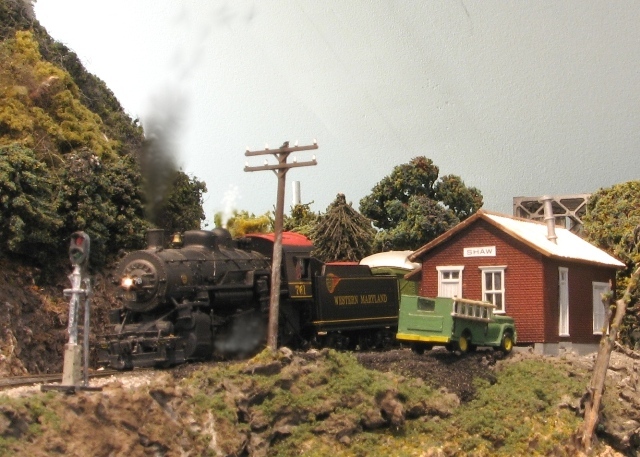
Next, this morning I rebuilt the area around Shaw. This is where the original section of the layout joined the temporary section, and the benchwork was a scabbed together mess. I needed to change the elevation, since the grade would be ascending here now, instead of descending as the temp loop had it. I also wanted to replace the subroadbed with proper 1/2" plywood, instead of the 1/4" paneling/3/4" foam sandwich I used originally. Here's what it was:
You can see pretty clearly that the engine is headed down grade. The point where the locomotive is in that picture is now about a full inch and a quarter higher than it was.


You can also see that I've made provision to add a Tortoise to run the siding at Shaw. There will be two short passing tracks on the Thomas sub, on either side of the scenic divider. Probably long enough to handle about 15 cars, or 20 55-T hoppers. I'm going to put the controls for both at the end of the peninsula so one tower operator can control movements on both sides. The switch into the truck dump at Shaw will remain manually operated by the train crew.


This shot reveals that the alignment will remain the same through the junction, just at a higher elevation.


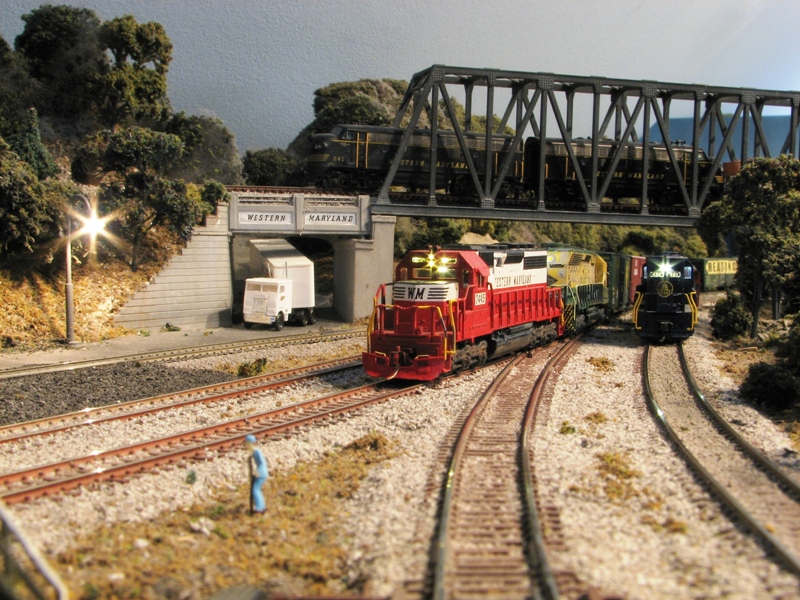
The grade change has put the truss bridge at just about level. Compare this to the old view:

The bridge originally dropped about 3/8" from left to right, which was to accommodate the original track plan. I grew weary of having to adjust photos to compensate for the stiff grade, and I'm glad to be rid of it. Now I just have to build up the center pier, which now will have room for proper bridge feet.


Here's the track to the Shaw truck dump. I think I'm going to re-purpose this siding as a sand load out. There was a source for silica sand near Shaw that was shipped to PPG in Cumberland in two-bay covered hoppers... I sure have a lot of them, and this will put them to good use. I'll carefully relocate the truck dump over to Thomas on the other side of the peninsula. You can see in the picture that I filled the void left by the grade change with some HO scale ballast I have laying around. I use this a lot for filler. I just dump it through the track, brush it out so it's all below the ties, then apply my glue soup to it. Once it sets up, I go back over it with N scale ballast and scenic materials, and when it's done, it'll be nice and blended in.

I'll have to get some of those clip strips for the Tortoise here, because it's located smack dab over the staging yard, and there's no way I'll be able to wire it from underneath. This will also be the first pairing of machines that will get the decoder experiment. I'd also like to apply some simple signaling here. (open-green, closed red) probably as fascia indicators since the Thomas Sub was TO/TT territory. A working TO signal would be fun to have at Shaw, too, and this is where the lighted TO stand from Williamsport Jct. will likely end up.

I'm trying to get all the connection elevations set so when the crew comes down for a work day all the math is already done.

Sunday, June 20, 2010

Success!

My clean up effort was delayed until after dinner due to another project (for pay) that I had been procrastinating... but that got far enough along that I could grab the broom and dust pan and trudge up to tackle the Blob.
After about two hours of sorting, sifting and sweeping, I finally got to the point where I could turn around in the room without knocking anything over. Behold! The Floor exists! There's still a few piles of junk to go through, but they are now the exception rather than the rule. At least in the train room... The Blob lives on in the workshop area now...


Oh well... it may be on the move, but at least it's getting smaller. I figure in an evening's time, I can get all this crap sorted and either put away, or bundled off for the dust man. Either way, I can start plotting the next push on the benchwork now, and yes, sleep a little more peacefully!