The ongoing saga of the transformation of my N scale layout into a more streamlined, operations-oriented model railroad.
Monday, February 28, 2011
Less is Better
For me, yesterday's challenge was to get a train running the full route of the layout. Fortunately, Bryan and Dave had other ideas.
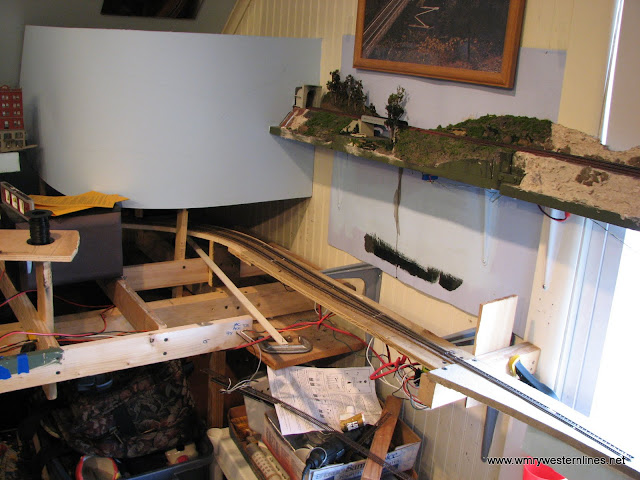
So, instead of focusing on my need for instant gratification, we focused on building a proper frame to ultimately carry the main line as well as the yard through the gap. So, it'll probably be a few more weeks, or perhaps days, before I can lay those last few pieces of track to connect the dots.
If I had one more piece of plywood on hand in the garage, we might have finished the job, but as it is, this is better, because I'll still have good access to the subterranean staging yard to finish up a few jobs down there before I close it all up.
Thanks to Bryan and Dave for making the trek down, and for keeping my eyes on the prize.
Saturday, February 26, 2011
Company's Coming!
Once again the Railwire Field Service has dispatched another team of skilled craftsman to unleash their talents on the N Scale Western Maryland. Traveling from points all over the globe, including upper Delaware, they will be descending (or is it ascending?) on my attic to help me make the final push to get a train running fully from Point A to Point B.
Of course, this means several critical things have to take place today. First, the beer fridge will need to be properly stocked. Everyone knows that a machine works better when well lubricated...
Second, I'll need to get a rake and a dumpster to clear the aisles so we can actually move about in the room to get things done. This will be no small task. Since there are wiring projects to do, much of the junque that's stowed beneath the layout has to be pulled out. At the same time, there will be carpentry and track work going on above decks, so there's a need for floor space.
Somewhere amid all this confusion, hopefully we'll be able to check off the items on the "to do" list. These include:
- Adjusting and wiring the staging yard turnouts (hopefully I can get this done tonight, but don't hold your breath)
- Building the necessary supports to carry the new yard platform.
- Installing the remaining 24 feet or so of track to tie the two ends of the railroad together. (Maybe I should have some champagne on hand to go with the beer!)
- Then putting in the gazillion wire drops that will be necessary to make the whole mess work.
Tuesday, February 22, 2011
The Slippery Slope...
I do this all the time... I've got a pile of projects that HAVE to be done, but I get myself all wrapped around stuff that I'd rather do. You know the feeling. There's that pesky turnout machine that requires about 10 minutes of laying on your back under the benchwork to make a 1/16th of an inch adjustment, but wouldnt' it be more fun to play with track to lay out the yard throat?
There's also screening to staple up around the helix to keep derailments from hitting the floor, or becoming eternally lost in the storage tubs that will live in the nether regions below the railroad, but that's not fun! Running trains up and down the helix, now THAT's fun!
With helpers, no less! I justify this goofing off with the idea that the helix should be well tested before I close it all up. But really, it's just goofing off.
Despite it all, it's still productive to do these things. I've got the crew coming down this weekend to help finish up a temporary connection so I can run the full circuit around the layout, so there are things that should be in place when they arrive, such as the panel that will carry the yard throat over the helix. And of course, you can't cut the panel to the appropriate size until you layout the track for the yard throat... So that's what I did tonight, even though it might be months before I actually build the yard. (Somehow I doubt that.)
There's still plenty to do, but it's pretty satisfying to get this piece of business out of the way. Tomorrow I promise I'll wire those switch machines. Honest.
There's also screening to staple up around the helix to keep derailments from hitting the floor, or becoming eternally lost in the storage tubs that will live in the nether regions below the railroad, but that's not fun! Running trains up and down the helix, now THAT's fun!
With helpers, no less! I justify this goofing off with the idea that the helix should be well tested before I close it all up. But really, it's just goofing off.
Despite it all, it's still productive to do these things. I've got the crew coming down this weekend to help finish up a temporary connection so I can run the full circuit around the layout, so there are things that should be in place when they arrive, such as the panel that will carry the yard throat over the helix. And of course, you can't cut the panel to the appropriate size until you layout the track for the yard throat... So that's what I did tonight, even though it might be months before I actually build the yard. (Somehow I doubt that.)
There's still plenty to do, but it's pretty satisfying to get this piece of business out of the way. Tomorrow I promise I'll wire those switch machines. Honest.
Friday, February 11, 2011
Closing in on a Milepost.
Well, it's just over a year since the reconstruction of the Western Maryland Western Lines began, and I'm actually pretty pleased with the volume of progress I've made thus far.
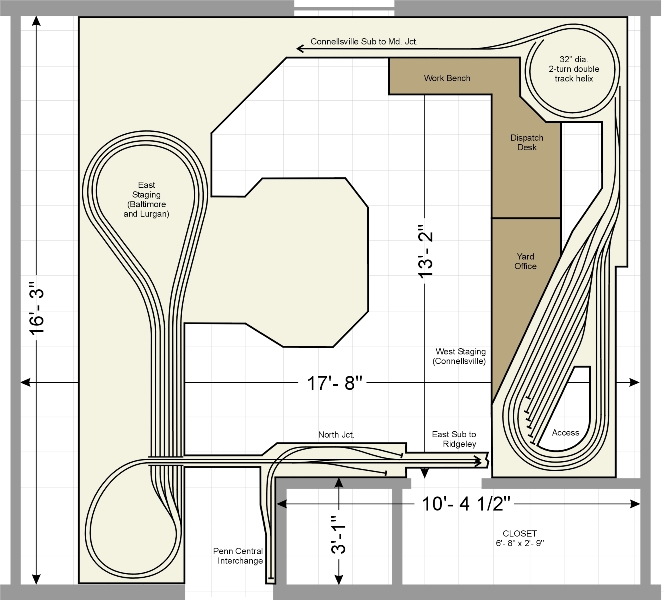
Last night I made a significant advance by installing the 32" diameter helix I constructed over the course of a week. It goes in the corner, and will carry the Connellsville line down to the staging yard under Ridgeley. At this moment, there's about five feet of railroad to build to make this connection, which should be complete over the weekend.
The beginnings of the west yard throat will be just above this monster eventually, but I think I'm going to cheat a little and run a temporary track around there to make a connection to North Junction and on to east staging. This will afford me the opportunity to run trains in earnest for the first time in about year.
Like the initial section of the layout over by the paper mill, I constructed the bulk of the helix off-site (at the kitchen table to be precise) to make it easier to align the track, do the wiring, and otherwise try to get it right. Once completed, I hauled it up the steps to the attic. Amazingly, the vertical dimensions worked out to within 1/8", which was easily handled by the leveling screws on the legs. I secured it to the wall to eliminate any wobble.
The outer track on the twist has a radius of 16", and the inner 14.5" Ascending trains will have the wider berth to reduce friction as much as possible. It will be interesting to test to see how long a train can reasonably manage the climb. The overall rise goes from 31.5" to 38.75" in two and a quarter turns. Not sure how the math works out on that, but I'm sure it won't be long before someone chips in with that calculation. It doesn't look like more than a brace of SD40's can handle. I'm hoping I can maintain my projected train length of 30 cars.
Anyway, that's all for now. Stay tuned for further developments.
Last night I made a significant advance by installing the 32" diameter helix I constructed over the course of a week. It goes in the corner, and will carry the Connellsville line down to the staging yard under Ridgeley. At this moment, there's about five feet of railroad to build to make this connection, which should be complete over the weekend.
The beginnings of the west yard throat will be just above this monster eventually, but I think I'm going to cheat a little and run a temporary track around there to make a connection to North Junction and on to east staging. This will afford me the opportunity to run trains in earnest for the first time in about year.
Like the initial section of the layout over by the paper mill, I constructed the bulk of the helix off-site (at the kitchen table to be precise) to make it easier to align the track, do the wiring, and otherwise try to get it right. Once completed, I hauled it up the steps to the attic. Amazingly, the vertical dimensions worked out to within 1/8", which was easily handled by the leveling screws on the legs. I secured it to the wall to eliminate any wobble.
The outer track on the twist has a radius of 16", and the inner 14.5" Ascending trains will have the wider berth to reduce friction as much as possible. It will be interesting to test to see how long a train can reasonably manage the climb. The overall rise goes from 31.5" to 38.75" in two and a quarter turns. Not sure how the math works out on that, but I'm sure it won't be long before someone chips in with that calculation. It doesn't look like more than a brace of SD40's can handle. I'm hoping I can maintain my projected train length of 30 cars.
Anyway, that's all for now. Stay tuned for further developments.
Thursday, January 27, 2011
The Contemplative Process
As I forge ahead with my seemingly endless endeavor to rebuild my N scale empire, I'm discovering that the various phases of the project generally proceed along the same basic sequence.
First, I find myself standing in the train room, usually in my pajamas with a coffee cup in my hand, staring obliquely at whatever the current obstacle is that's confronting me. This process can be repeated for several days, or over the course of several weeks or even months. Usually these silent vigils take place in increments of about 10 minutes to an hour. It depends on how hungry I am.
During these periods, my mind will alternately slip in and out of gear. At the more productive moments, it's envisioning the finished scene, or the complex turnout linkage, or fully lit grouping of structures and vehicles. These thoughts are quickly replaced by a spell where I just stare blankly at the framework, as I go over the "to do" list that will be required to get from what I'm looking at right now, to what I fantasized about a moment earlier.
Next, I heave a sigh, scratch my head, then take a sip from my coffee cup, which has gone stone cold during the elapsed time.
If it's my day off, I may swing into action and start to tackle the list that will nudge me ever closer to the goal. This list may include actual model railroading activities, such as plugging in the soldering pencil, or moving some rolling stock out of harm's way, but usually it starts with such mundane activities as getting dressed so I can head out to the garage to find a piece of lumber or a box of screws. If my wife isn't home, I may bypass the whole getting dressed thing, and just put on my slippers for the trek across the driveway. (These are usually my least productive outings.)
The first trip to the garage is generally an assessment of the inventory at hand, which may lead to a safari to the lumberyard or hardware to fill in any missing gaps. There's so much stuff stockpiled, though, that this is rarely needed.
Returning to the train room, which is in the attic, a full three flights of stairs from the garage, I quickly realize that a critical tool or piece of material has been left down on the workbench. This scenario will be repeated throughout the day, and this constitutes the extent of my physical fitness regimen.
Another recurring theme in my layout construction is the law of "One Step Forward Requires Two Steps Back." This means that before any real forward progress can be recorded, some hastily concocted shortcut will have to be undone. Most recently, this involved the relocation of a turnout that I had installed to close up the long siding on the Connellsville Sub.
That's it there in the middle of the shot. When I did this, my main concern was keeping the turnout on the "fixed" portion of the layout, and not on the removable section I have to install in front of the window. I had neglected to verify that this location would provide the desired minimum train length of 30 cars, plus 2-3 locomotives and a caboose. Once the glue dried and everything was in place, I checked this, and was disappointed to see that I was stuck at around 28 cars.
I walked away, and resumed the ritual with the pajamas etc. for several weeks.
The other night, I resolved to work on the removable section, which involved re-working an existing module so that it would fit in the space, span the window, and provide the base elevations so I could make the final adjustments on the previous work, and set the grades for the sections beyond the window to the right. This was fun, and led me to a solution on the Connellsville Sub siding issue.
You can see the turnout will now appear on the removable section, which will require additional wiring connections, but I'll work that out. The worst part will be digging in to the old scenery, and making a hole in the plywood deck to make room for the Tortoise switch machine that will run the turnout. Not impossible, to be sure, but it will take a bit of head scratching.
So next time we chat, odds are I'll be in my pajamas clutching a coffee cup and staring blankly at a hole drilled in a bit of plywood.
And so it goes.
First, I find myself standing in the train room, usually in my pajamas with a coffee cup in my hand, staring obliquely at whatever the current obstacle is that's confronting me. This process can be repeated for several days, or over the course of several weeks or even months. Usually these silent vigils take place in increments of about 10 minutes to an hour. It depends on how hungry I am.
During these periods, my mind will alternately slip in and out of gear. At the more productive moments, it's envisioning the finished scene, or the complex turnout linkage, or fully lit grouping of structures and vehicles. These thoughts are quickly replaced by a spell where I just stare blankly at the framework, as I go over the "to do" list that will be required to get from what I'm looking at right now, to what I fantasized about a moment earlier.
Next, I heave a sigh, scratch my head, then take a sip from my coffee cup, which has gone stone cold during the elapsed time.
If it's my day off, I may swing into action and start to tackle the list that will nudge me ever closer to the goal. This list may include actual model railroading activities, such as plugging in the soldering pencil, or moving some rolling stock out of harm's way, but usually it starts with such mundane activities as getting dressed so I can head out to the garage to find a piece of lumber or a box of screws. If my wife isn't home, I may bypass the whole getting dressed thing, and just put on my slippers for the trek across the driveway. (These are usually my least productive outings.)
The first trip to the garage is generally an assessment of the inventory at hand, which may lead to a safari to the lumberyard or hardware to fill in any missing gaps. There's so much stuff stockpiled, though, that this is rarely needed.
Returning to the train room, which is in the attic, a full three flights of stairs from the garage, I quickly realize that a critical tool or piece of material has been left down on the workbench. This scenario will be repeated throughout the day, and this constitutes the extent of my physical fitness regimen.
Another recurring theme in my layout construction is the law of "One Step Forward Requires Two Steps Back." This means that before any real forward progress can be recorded, some hastily concocted shortcut will have to be undone. Most recently, this involved the relocation of a turnout that I had installed to close up the long siding on the Connellsville Sub.
That's it there in the middle of the shot. When I did this, my main concern was keeping the turnout on the "fixed" portion of the layout, and not on the removable section I have to install in front of the window. I had neglected to verify that this location would provide the desired minimum train length of 30 cars, plus 2-3 locomotives and a caboose. Once the glue dried and everything was in place, I checked this, and was disappointed to see that I was stuck at around 28 cars.
I walked away, and resumed the ritual with the pajamas etc. for several weeks.
The other night, I resolved to work on the removable section, which involved re-working an existing module so that it would fit in the space, span the window, and provide the base elevations so I could make the final adjustments on the previous work, and set the grades for the sections beyond the window to the right. This was fun, and led me to a solution on the Connellsville Sub siding issue.
You can see the turnout will now appear on the removable section, which will require additional wiring connections, but I'll work that out. The worst part will be digging in to the old scenery, and making a hole in the plywood deck to make room for the Tortoise switch machine that will run the turnout. Not impossible, to be sure, but it will take a bit of head scratching.
So next time we chat, odds are I'll be in my pajamas clutching a coffee cup and staring blankly at a hole drilled in a bit of plywood.
And so it goes.
Tuesday, January 4, 2011
Holiday Progress
Here we are, the first post of the new year (2011). I was fortunate enough to have a few days off over the holidays, and took advantage of that time to press ahead with a couple of key projects. First, I continued to flesh out the scenery around Thomas, West Virginia, closing up the chasm between the yard there and the masonite fascia. This also included finishing out the base scenery along the Connellsville line on the lower level along the river bank.
This also involved completing the highway bridge leading out of Thomas. I used an old Atlas Warren Truss bridge as the basic component, and tricked it out with some Evergreen H beams and a styrene deck, then added some road striping with a yellow pencil. Finally, for the sake of the safety of my N scale motorists, I added some guardrails using Evergreen strip stock.
All that's left to do in Thomas is to construct the iconic brick station building, a couple of more company houses, and then work on detailing out the post and frame foundations. I have a stand in for the lumber mill operation, and a kit to bash to finish it, and of course, some trees, figures vehicles and so forth.
Next, I moved around the corner to start roughing in the framework for Cumberland, which will be my urban section. Since the benchwork is fairly deep at this area, I have to work from the back wall out, as I won't be able to easily reach the far sections once the mainline is installed through town. The Thomas Sub line to the helix runs behind Cumberland, and parallels my version of US 40 into the Narrows, a scene showcased in our last installment. Working forward from Route 40, I'm creating a typical highway commercial scene, replete with billboard signs, gasoline stations and fast food joints. So far things are just slapped in "for placement only" consideration, but I'll be refining this area in the coming weeks.
My time frame is around 1970, and I've been told that there wasn't a Pizza Hut in Cumberland until 1972, but I'll take that under advisement. The Pizza Hut got a "snow" job when I used it on a slap-dash Christmas Garden a few years ago, so I'll need to be repainting that. I'll also add some more details to the roof and landscape to make it look a little less Plasticville. Either that or I'll build a proper road side greasy spoon, but for now we'll stick with pizza. In the background you can see the larger buildings of Cumberland's main thoroughfare, Baltimore Street.
I'll be using some DPM structures, and kitbashing a few others to get the downtown feel here. I've also seen some Japanese Tomix buildings that look like they might work for the newer buildings that were constructed in the 1950's and '60's. We'll see what the budget allows for in the coming months.
As we proceed back toward the aisle, we pick up the segment of the mainline through town where the Western Maryland Station is to be located. I've been working on a scratchbuild of the station for some time, and this will give me the motivation to try to finish it.
The station scene will represent how the building looked in the early 1970's, with the middle platform removed. Baltimore Street crosses the tracks just to the left of the station, and there will be an interchange track for the B&O just to the right like the prototype. The panel in the foreground will be the stream bed for Wills Creek, which in this area is enclosed in a concrete flood control channel, as shown in the map below.The challenge for me will be to patiently work on these background scenes and get them to a level of completeness so I can confidently finish running Wills Creek from the back to the front, and then install the remainder of the main line. Usually I'm too impatient to do things in the proper order, and I end up regretting it later. I'm already struggling with myself on this one, as I really want to get the track installed in front of the station. Somehow I'll manage, I'm sure.
Friday, December 3, 2010
Making the Scene...
Been cobbling together some more scenery.
Here's some highlights:
Wills Creek, west of Cumberland. That would be US 40 there. This runs along the back edge of the layout, and will be difficult to access once I construct the main line through Cumberland, so I'm trying to tease out as complete a scene as I can before I close up the hole in the bench work.
Looking the other way. Once the scenery is closed up, the state highway department assures me that this will be a less dangerous curve...
High bridge over the Casselman River. This scene might seem confusing if you consider that the high bridge is on the Thomas Sub in West Virginia, while the low line is somewhere between Deal and Meyersdale in Pennsylvania. Ah the joys of selective compression!
Another view. The scene remains incomplete, I need to add the walkway on the near side of the bridge. The engine is a Walther's 0-8-0 into which I recently installed a decoder. It currently resides in Minnesota. I like this photo angle... More trees will do just the right trick.
As you may have guessed, building out the scenery is my favorite part of the hobby. I regard tracklaying and wiring as necessary evils, but once they're done, I'm slinging mud and planting trees and other details. I'll try to keep you updated on progress as it happens. I'm going to try to finish out the Thomas scene in the next week or so, then I'll be making the push to get the business district along US 40 done. After that, I can get back to the dull stuff to get Cumberland operational.
Here's some highlights:
Wills Creek, west of Cumberland. That would be US 40 there. This runs along the back edge of the layout, and will be difficult to access once I construct the main line through Cumberland, so I'm trying to tease out as complete a scene as I can before I close up the hole in the bench work.
Looking the other way. Once the scenery is closed up, the state highway department assures me that this will be a less dangerous curve...
High bridge over the Casselman River. This scene might seem confusing if you consider that the high bridge is on the Thomas Sub in West Virginia, while the low line is somewhere between Deal and Meyersdale in Pennsylvania. Ah the joys of selective compression!
Thomas, West Virginia. I've been working on the company town housing along the ridge. I'm happy with the way the town is coming together. I'm working my way from the skyboard out to the fascia, gradually filling in the peninsula. You can see the Wills Creek scene just above the Cool Whip tub I use to mix up my Sculptamold. The big factory in the back is Kingsford Charcoal.
Detail of a "Company House" duplex, abandoned, and gradually returning to nature. That was kind of fun to do!
As you may have guessed, building out the scenery is my favorite part of the hobby. I regard tracklaying and wiring as necessary evils, but once they're done, I'm slinging mud and planting trees and other details. I'll try to keep you updated on progress as it happens. I'm going to try to finish out the Thomas scene in the next week or so, then I'll be making the push to get the business district along US 40 done. After that, I can get back to the dull stuff to get Cumberland operational.
Subscribe to:
Posts (Atom)